
Road Name Stories
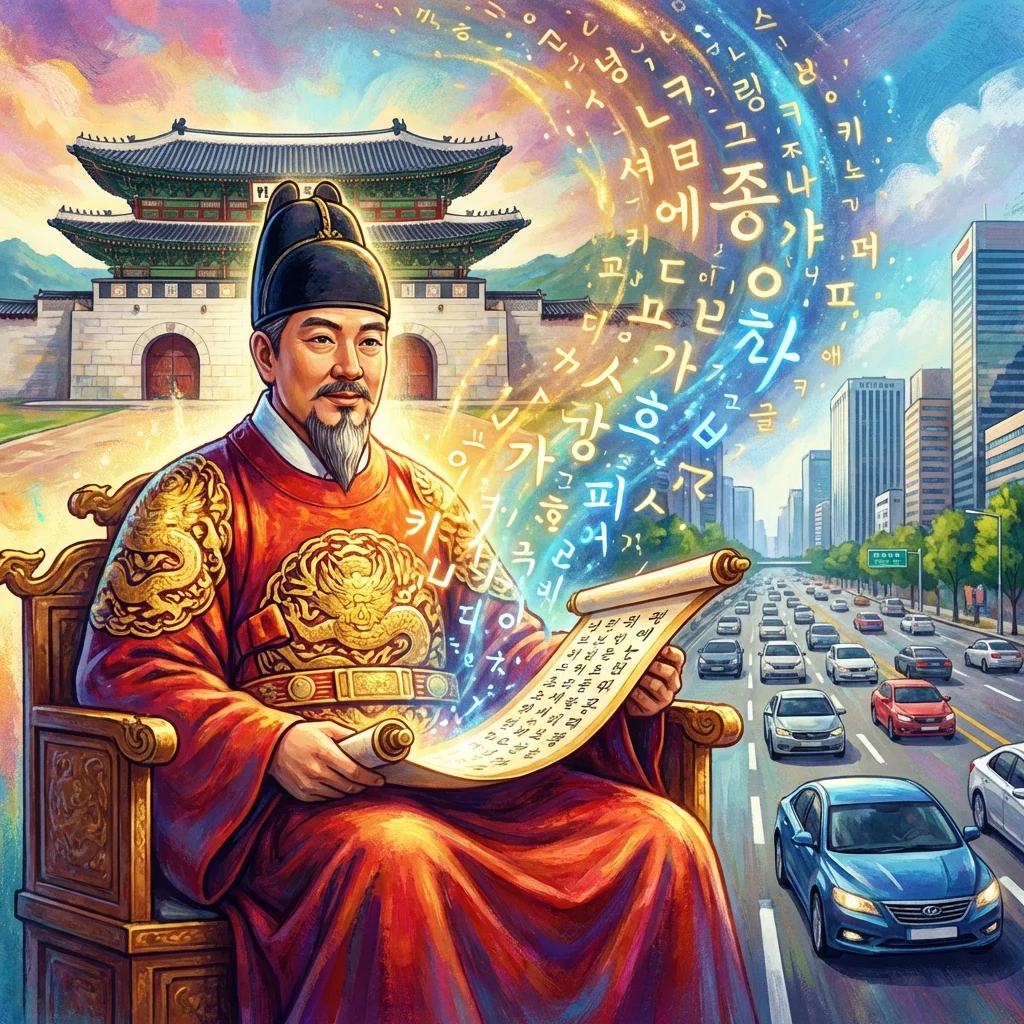
Road of King Sejong the Great
Sejong-daero is the grand boulevard that runs from Gwanghwamun Gate to Seoul Station—approximately 1.2 kilometers that serve as the symbolic spine of the South Korean capital. The road was formed in 2010 by merging two older streets, Sejong-ro and Taepyeong-ro, into a unified axis.
The name honors King Sejong the Great (r. 1418–1450), the fourth monarch of the Joseon Dynasty and one of the most revered figures in Korean history. Sejong created Hangeul, the Korean alphabet, in 1443—designing it specifically so that ordinary people, not just scholars trained in Chinese characters, could read and write. He also oversaw the invention of the rain gauge, the sundial, water clocks, and a celestial globe; supported the composition of native Korean music; and led successful military campaigns to secure Korea's northern borders. His reign is often called the golden age of Joseon.
During the Joseon Dynasty, this street was known as Yukjo-geori (六曹街, "Street of the Six Ministries")—the administrative heart of the kingdom. The six central government ministries (Personnel, Revenue, Rites, Military Affairs, Justice, and Public Works) lined both sides of the road, their gates facing the boulevard in a carefully ordered display of state power. Yangban officials on horseback passed daily; ordinary citizens were confined to the side lanes.
Today, Sejong-daero hosts Gyeongbokgung Palace, the National Museum of Korean Contemporary History, the Government Complex-Seoul, and Gwanghwamun Square—where a towering bronze statue of King Sejong gazes down the boulevard he now names. Below the statue lies the "Story of King Sejong" underground exhibition, where visitors can experience the creation of Hangeul in an immersive space. From the Six Ministries to the digital age, this road has been the axis of Korean public life for over 600 years.
References
Landmarks on Sejong-daero
Explore every address on Sejong-daero
Get the official road addresses and zip codes instantly.