
Road Name Stories
The Spirit of General Eulji Mundeok
Eulji-ro runs approximately 2.7 kilometers from Seoul City Hall to Dongdaemun History & Culture Park, cutting through the historic heart of Jung-gu. Today it is one of Seoul's most talked-about streets—but its character was shaped over centuries, not overnight.
During the Japanese colonial period (1910–1945), the street was called Hwanggeum-jeong (黃金町, "Gold Town"), a Japanese-style name imposed to erase Korean identity. After liberation in 1945, Koreans set about reclaiming their city's geography. In 1946, the street was renamed Eulji-ro in honor of General Eulji Mundeok of the ancient Goguryeo Kingdom—the commander who, in 612 CE, masterminded the destruction of a 300,000-strong Sui Chinese invasion at the Battle of Salsu River. His famous poem to the enemy general—"Your divine strategy has plumbed the heavens, your military tactics have exhausted the earth"—was laced with sarcasm designed to lure the enemy into a devastating ambush. The choice of name was pointed: the area had a large Chinese-Korean population, and naming the street after the man who defeated China's greatest dynasty was a quiet assertion of Korean pride.
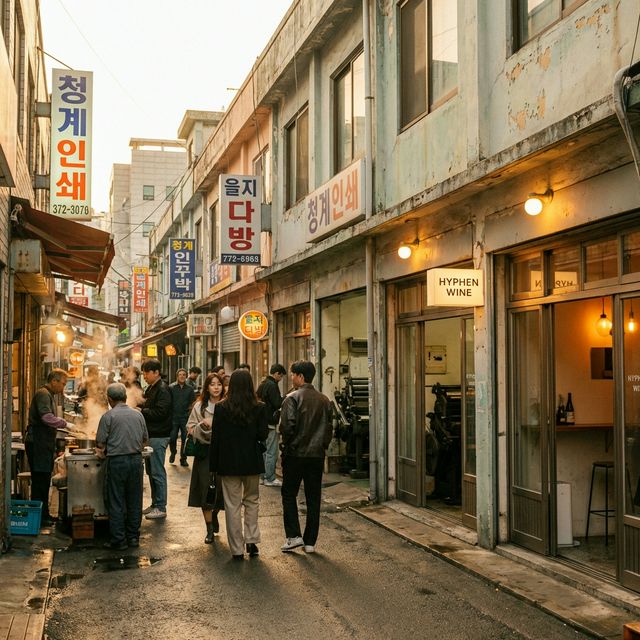
In the 1960s and 70s, Eulji-ro became the industrial backbone of Korea's economic miracle. Printing presses, lighting suppliers, hardware wholesalers, and metalworkers packed every alley. Signs were hand-painted, machines ran day and night, and the smell of machine oil was part of the air. Workers and merchants called it the engine room of Korean manufacturing.
Then came the 'Hipji-ro' era. Around 2016, young Seoulites—drawn by the gritty textures the internet generation calls "retro"—started discovering rooftop bars hidden above old ironworks, traditional soup restaurants tucked between tool shops, and late-night pojangmacha stalls that had been there for decades. The nickname 'Hipji-ro' (Hip + Eulji-ro) went viral, and a new cultural layer was added to this ancient street without erasing the old one. Today, a 60-year-old metal shop and a craft cocktail bar can share the same building—a coexistence that feels uniquely Seoul.
References
Landmarks on Eulji-ro
Explore every address on Eulji-ro
Get the official road addresses and zip codes instantly.